
- News
- Ambedkar's Prime Cut
This story is from March 8, 2015
Ambedkar's Prime Cut
Several states have moved away from the liberal compromise engineered by him on the touchy issue of cattle slaughter while framing the Constitution.

Several states have moved away from the liberal compromise engineered by him on the touchy issue of cattle slaughter while framing the Constitution. With Maharashtra joining the band wagon last week of states banning cattle slaughter, India would appear to have become more conservative than it was while framing its Constitution over six decades ago.
ECONOMIC ISSUE, NOT RELIGIOUS
The term “compromise“ was used by one of the proponents of the clause in the Assembly, Ram Sahai. They had originally demanded its insertion as no less than a fundamental right, which, unlike a directive principle, was binding on the State and enforceable in a court of law. But Ambedkar, with the backing of Congress leadership, had forced them to settle for the compromise under which Pandit Thakur Dass Bhargava proposed the amendment in the Constituent Assembly merely as a directive principle. As a strategy for making it acceptable to a body committed to a pluralist vision of India, Bhargava was also compelled to remove any admission in the clause that the concern for cattle was driven by any religious sentiment. Instead, Bhargava's amendment, which was adopted by the Constituent Assembly on November 24, 1948, had been framed purely as an economic issue, as part of a larger objective “to organise agriculture and animal husbandry on modern and scientific lines“.
HOW THEY AGREED
Seth Govind Das, another ardent votary of the anti-slaughter clause in the Assembly, gave a peep into how Ambedkar had his way in the backroom negotiations, on the strength of rationality. “I had then stated that just as the practice of untouchability was going to be declared an offence so also we should declare the slaughter of cows to be an offence. But it was said that while untouchability directly affected human beings, the slaughter of cows affected the life of animals only and that as fundamental rights were for human beings, this provision could not be included therein,“ Das said, adding that he “did not protest against that view and thought it proper to include this provision in the directive principles“.

MUSLIM LEAGUE PROTESTS
Despite all the responsibility ascribed to him by Hindu hardliners for the language and location of the anti-slaughter clause, Ambedkar did not own up to any of it in the course of the debate in the Assembly . All he said was that he accepted Bhargava's amendment, paving the way for its adoption. Ambedkar remained tacit even after a couple of Muslim League members had expressed preference ironically for the draft originally demanded by Hindu hardliners. Syed Muhammad Saiadulla alleged that those trying to pass it off as an economic issue “create a suspicion in the minds of many that the ingrained Hindu feeling against cow slaughter is being satisfied by the backdoor“.
Another Muslim League member, ZH Lari, objected to the conversion of the clause from a fundamental right to a directive principle. His reason: “it is better to come forward and incorporate a clause in fundamental rights that cow slaughter is henceforth prohibited, rather than it being left vague in the directive principles, leaving it open to provincial governments to adopt it one way or the other.“
In his classic, The Indian Constitution: Cornerstone of a Nation, Granville Austin seemed to endorse Saiadulla's contention that the clause against cow slaughter detracted from India's secularism. Despite Ambedkar's success in diluting it, Austin wrote, “Article 48 shows that Hindu sentiment predominated in the Constituent Assembly.“ State governments have since disregarded HM Seervai's exposition in his Constitutional Law of India that the Article 48 protection “did not extend to cattle which at one time were milch or draught cattle but had ceased to be such“. Reversing its own consistent rulings, the Supreme Court in 2005 held that the ban envisaged by Article 48 extended to all the cattle, irrespective of their age and the strain they put on the availability of fodder. Maharashtra's decision fits in with the pattern of moving away from the liberal compromise struck by Ambedkar.
Though the restrictions in various states are traced to the “directive principle of state policy“ contained in Article 48 of the Constitution, there was no trace of this provision in the first draft published in February 1948 by the drafting committee of the Constituent Assembly headed by BR Ambedkar. The clause enjoining the State to take steps for “prohibiting the slaughter of cows and calves and other milch and draught cattle“ surfaced in a subsequent draft, thanks to a backroom “compromise“ between some upper caste Congress members and the Dalit leader.
ECONOMIC ISSUE, NOT RELIGIOUS
The term “compromise“ was used by one of the proponents of the clause in the Assembly, Ram Sahai. They had originally demanded its insertion as no less than a fundamental right, which, unlike a directive principle, was binding on the State and enforceable in a court of law. But Ambedkar, with the backing of Congress leadership, had forced them to settle for the compromise under which Pandit Thakur Dass Bhargava proposed the amendment in the Constituent Assembly merely as a directive principle. As a strategy for making it acceptable to a body committed to a pluralist vision of India, Bhargava was also compelled to remove any admission in the clause that the concern for cattle was driven by any religious sentiment. Instead, Bhargava's amendment, which was adopted by the Constituent Assembly on November 24, 1948, had been framed purely as an economic issue, as part of a larger objective “to organise agriculture and animal husbandry on modern and scientific lines“.
HOW THEY AGREED
In the debate that preceded the adoption of the clause on that day, Bhargava and other opponents of cattle-slaughter made repeated and pointed references to Ambedkar's role in forcing them to climb down in off-the-record negotiations. Bhargava went to the extent of saying that the language of the clause proposed by him was actually Ambedkar's “manufacture“. Calling it “an agreed amendment“, Bhargava said, “While moving this amendment, I have no hesitation in stating that for people like me and those that do not agree with the view of Ambedkar and others, this entails, in a way , a sort of sacrifice.“ Yielding to the approach of solving the problem “without using any sort of coercion“, Bhargava said, “To my mind, it would have been much better if this could have been incorporated in the fundamental rights, but some of my Assembly friends differed and it is the desire of Ambedkar that this matter, instead of being included in fundamental rights should be incorporated in the directive principles.“
Seth Govind Das, another ardent votary of the anti-slaughter clause in the Assembly, gave a peep into how Ambedkar had his way in the backroom negotiations, on the strength of rationality. “I had then stated that just as the practice of untouchability was going to be declared an offence so also we should declare the slaughter of cows to be an offence. But it was said that while untouchability directly affected human beings, the slaughter of cows affected the life of animals only and that as fundamental rights were for human beings, this provision could not be included therein,“ Das said, adding that he “did not protest against that view and thought it proper to include this provision in the directive principles“.
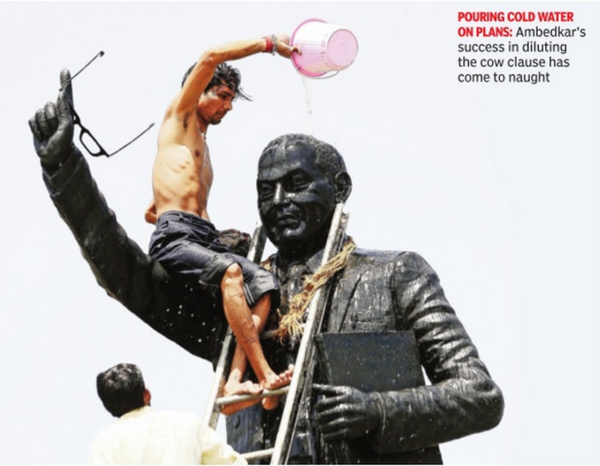
MUSLIM LEAGUE PROTESTS
Despite all the responsibility ascribed to him by Hindu hardliners for the language and location of the anti-slaughter clause, Ambedkar did not own up to any of it in the course of the debate in the Assembly . All he said was that he accepted Bhargava's amendment, paving the way for its adoption. Ambedkar remained tacit even after a couple of Muslim League members had expressed preference ironically for the draft originally demanded by Hindu hardliners. Syed Muhammad Saiadulla alleged that those trying to pass it off as an economic issue “create a suspicion in the minds of many that the ingrained Hindu feeling against cow slaughter is being satisfied by the backdoor“.
Another Muslim League member, ZH Lari, objected to the conversion of the clause from a fundamental right to a directive principle. His reason: “it is better to come forward and incorporate a clause in fundamental rights that cow slaughter is henceforth prohibited, rather than it being left vague in the directive principles, leaving it open to provincial governments to adopt it one way or the other.“
In his classic, The Indian Constitution: Cornerstone of a Nation, Granville Austin seemed to endorse Saiadulla's contention that the clause against cow slaughter detracted from India's secularism. Despite Ambedkar's success in diluting it, Austin wrote, “Article 48 shows that Hindu sentiment predominated in the Constituent Assembly.“ State governments have since disregarded HM Seervai's exposition in his Constitutional Law of India that the Article 48 protection “did not extend to cattle which at one time were milch or draught cattle but had ceased to be such“. Reversing its own consistent rulings, the Supreme Court in 2005 held that the ban envisaged by Article 48 extended to all the cattle, irrespective of their age and the strain they put on the availability of fodder. Maharashtra's decision fits in with the pattern of moving away from the liberal compromise struck by Ambedkar.
End of Article
FOLLOW US ON SOCIAL MEDIA
Hot Picks
TOP TRENDING
Trending Stories
In Section
Entire Website
- Breathtaking cosmic catwalk! SpaceX makes history with first-ever private spacewalk
- 2 Army officers thrashed, their female friend gang-raped in Madhya Pradesh
- Bangladesh announce Test squad for India tour
- Top fastest trains in the world: From China's CR Harmony to Germany's ICE
- Amid Shannon Sharpe Viral Video, Former ESPN Host Michelle Beadle Reacts Claiming It Was Not Her
- Ayushman Bharat insurance scheme expanded to cover elderly above 70
- 'Will be demolished if... ': Himachal minister's assurance amid Shimla mosque row
- Mumbai's Haji Ali and Mahim dargahs cancel Eid shamiana
- Garena Free Fire MAX redeem codes for September 11, 2024: Win free room cards, skins, diamonds, pet skins, and more rewards today
- GK for students: Top 8 Largest Mammals in the World
- On Mamata's 'ready to resign' offer, protesting doctors say 'want solution to RG Kar stalemate'
- Putin invites 'great friend' PM Modi for talks on sidelines of BRICS summit
- Why are Bangladeshi Hindus in India for 50 yrs still not Indians?
- 'Leading light of the Left': Sitaram Yechury passes away; PM Modi, Rahul condole demise
- 'Deal with it': Oppn vs BJP over PM Modi attending Ganpati Puja at CJI's house
- Trump aide says 'White House will smell like curry' if Kamala wins
- Actor dies in his sleep. Why sudden heart attacks are killing Indians
- What Airtel CEO Gopal Vittal wrote in letter to Jio, Vi, Tata Tele and BSNL CEOs
- US Presidential Election Top 10: Is Donald Trump done as an orator?
- 'Air taxis to soon become a reality in India': PM Modi

Popular Categories
Hot on the Web
Top Trends
Trending Topics
Alia BhattMalaika Arora Father DeathArbaaz KhanNatasa StankovicMr Bachchan OTT ReleaseNational Parks In IndiaSelena GomezGOAT CollectionVikas Sethi DeathMalayalam ProducersIndia's Best Dancer 4Simi GarewalDilli BabuIndian National ParksLaung BenefitsVikas SethiiPhone 16Dubai Princess Sheikha MahraMG Windsor EvWordle Answer
Living and entertainment
Latest News
Epilepsy medication shows promise of treating sleep apnoea symptoms: StudyDigest this: Unhealthy gut may be linked to Parkinson’s disease'Played a big role in turning the cricket around': Ricky Ponting applauds Virat Kohli’s brilliance as India’s former captainAadhaar card update: Do you have to compulsorily update details on your Aadhaar every 10 years?Single Indians are now choosing slow, meaningful dates over-elaborate outings, reveals an online dating platform’s surveyExclusive- Saurabh Gumber reveals joining a new show during Ganeshotsav says, "I consider it as Bappa's small gift and believe he has great plans for me ahead"Pakistan: Bilawal cautions Shehbaz govt against political victimisation, points to Imran Khan's caseVijay Varma reveals he was DROPPED from 'Sacred Games' at the last minuteMahindra Thar Roxx with VIN 0001 to be auctiond for charity: How to registerVijay Sathya-starrer 'Dhil Raja' to release in SeptemberHarvard University Sees Drop in Black Freshman Enrollment Post-Supreme Court Ruling on Affirmative ActionArbaaz Khan spotted outside Malaika Arora's house along with police after the tragic news of her father's demise by alleged suicide - WATCH VIDEOHarvey Weinstein charged with additional crimes during hearing on rape chargesMitchell Schwartz's Cryptic Tweet Stirs Debate About Mahomes' ContractTovino Thomas praises Prithviraj Sukumaran as director: "One of the brilliant directors I have ever worked with"Border Gavaskar Trophy: When Sourav Ganguly's Brisbane heroics set the tone for an enlivening seriesBritain’s one of the largest mobile services providers BT Group raises cybersecurity alarm: “...every 90 seconds hackers are checking…”NTR Jr’s Devara crosses US $1 million mark for its premiere shows in USA with 15 days to release
Copyright © 2024 Bennett, Coleman & Co. Ltd. All rights reserved. For reprint rights: Times Syndication Service